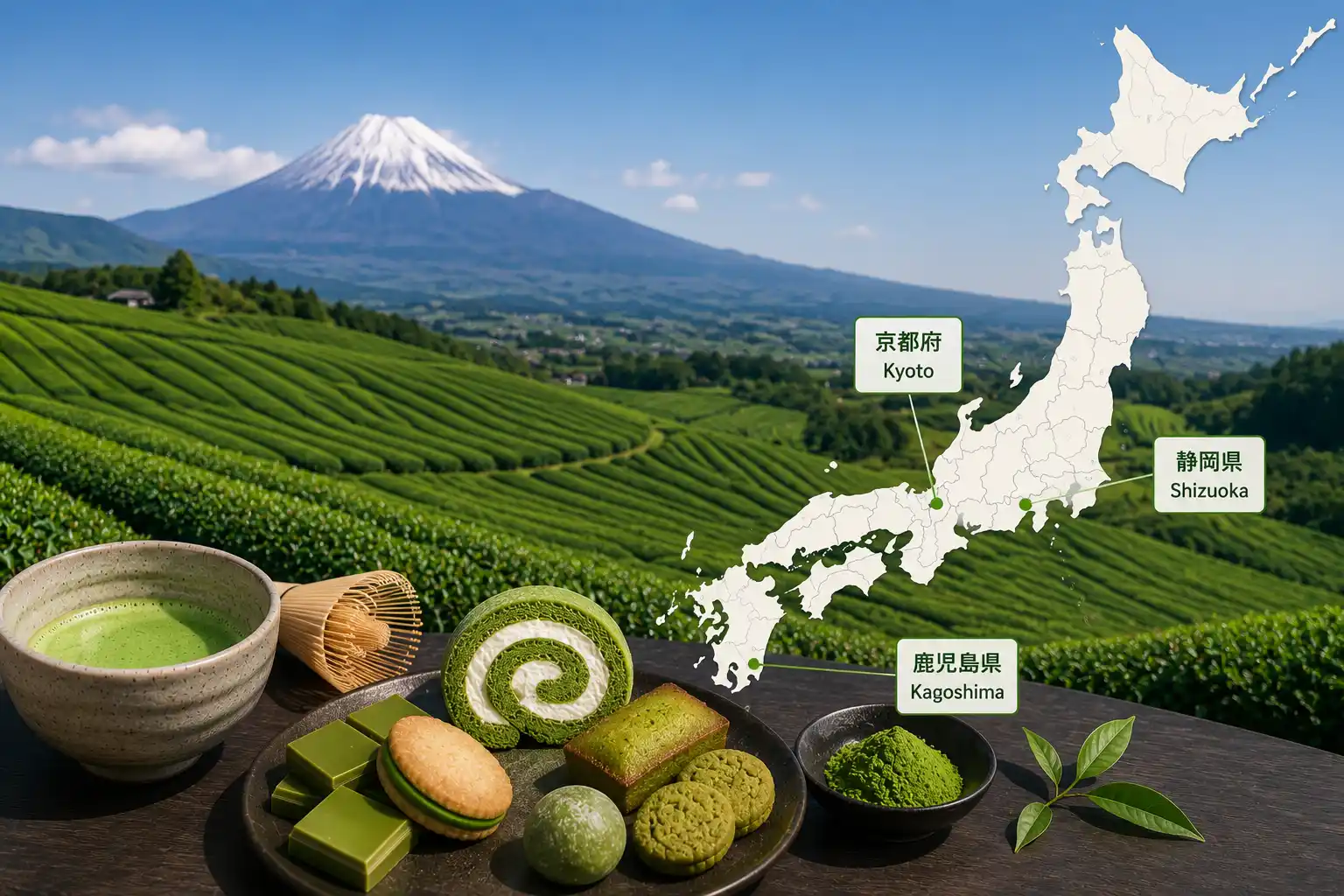
When people think of Japanese matcha, one place usually comes to mind first: Kyoto.
And for good reason.
Kyoto — especially Uji — has centuries of tea history behind it and remains one of Japan's most celebrated tea regions.
But here's something many people outside Japan don't realize:
Japanese matcha doesn't stop at Kyoto.
Shizuoka has Japan's largest tea-growing area. Kagoshima has risen to No. 1 in crude tea production. And today, Kyoto, Shizuoka, and Kagoshima are all important regions in the production of tencha — the tea used to make matcha.
Within Kagoshima itself, famous tea-growing areas such as Chiran and Kirishima add even more variety to the story.
And then there are Japanese matcha sweets — chocolate, cookies, cakes, ice cream, wagashi, and everyday matcha snacks that have helped turn this centuries-old tea into one of Japan's most recognizable flavors around the world.
So what exactly is matcha? Why does it work so well in sweets? And what lies beyond the famous matcha of Kyoto?
Let's take a trip through Japan's matcha map.
What Is Matcha?
Matcha isn't simply powdered green tea.
Authentic matcha is made from tencha, tea leaves grown under shade before harvest and processed specifically to be ground into an extremely fine powder.
With teas such as sencha, you steep the leaves in hot water and then remove them.
With matcha, you consume the powdered tea itself.
That gives matcha its distinctive combination of umami, gentle bitterness, vegetal notes, subtle sweetness, and rich aroma.
Matcha has deep connections to Japanese tea ceremony culture, but its role in Japan today extends far beyond the tea bowl.
You'll find it in traditional wagashi, chocolate, cookies, cakes, ice cream, parfaits, candy, and even limited-edition snacks at Japanese supermarkets and konbini.
That meeting of centuries-old tradition and modern snack culture is part of what makes Japanese matcha so fascinating.
Why Does Matcha Work So Well in Sweets?
Taste matcha on its own and you'll quickly notice that it isn't simply "bitter."
There's bitterness, yes — but also umami, aroma, freshness, and subtle natural sweetness.
Add something sweet and the balance changes.
White chocolate softens the bitterness. Milk and cream make matcha smoother. Butter adds richness. Traditional ingredients such as red bean and mochi bring out a completely different side of the tea.
When the balance is right, sweetness doesn't hide the matcha.
It makes the tea stand out.
That contrast between the slight bitterness of matcha and the sweetness of a dessert is one of the reasons Japanese matcha sweets work so well.
Kyoto & Uji: Where Matcha Tradition Runs Deep
If Japanese matcha has a famous home, Kyoto has a very strong claim.
Southern Kyoto Prefecture, particularly Uji and the surrounding tea-producing areas, has a long history of Japanese tea cultivation.
Uji tea includes several types of Japanese tea, including sencha, gyokuro, and tencha — the tea from which matcha is made. Its long connection with tea culture and the Japanese tea ceremony has helped make Uji matcha famous far beyond Japan.
Visit Kyoto today and matcha seems to be everywhere.
Traditional wagashi sit alongside matcha parfaits, soft serve, cookies, cakes, chocolates, and beautifully packaged sweets.
Kyoto's reputation is well deserved.
But it's only the beginning of Japan's matcha story.
Shizuoka: Japan's Tea Giant
Travel east and you'll find another giant of Japanese tea: Shizuoka.
For generations, Shizuoka has been synonymous with Japanese green tea, particularly sencha.
And even as Japan's tea industry changes, Shizuoka remains enormous.
Shizuoka still has the largest tea-growing area of any prefecture in Japan.
But its importance isn't just about size.
Tea is grown across a remarkable variety of environments, from broad fields to mountain slopes. Different elevations, climates, cultivars, and processing techniques create very different teas.
There really isn't one single "Shizuoka tea."
And Shizuoka is increasingly important to matcha as well. The prefecture is one of Japan's major regions for tencha, the raw material used to produce matcha.
So while Kyoto may dominate the international image of matcha, Shizuoka remains one of the true powerhouses of Japanese tea — and an increasingly important part of Japan's matcha story.
Kagoshima: Japan's New No. 1 Tea Producer
Now travel much farther south, to Kagoshima on the island of Kyushu.
This is where the story gets especially interesting.
In the latest full-year figures for 2024, Kagoshima produced approximately 27,000 tons of crude tea, compared with about 25,800 tons in Shizuoka, making Kagoshima Japan's No. 1 prefecture by crude tea production.
And the momentum continued.
In 2025, Kagoshima also took the No. 1 position in Japan for first-flush crude tea production for the first time, producing about 8,440 tons.
For anyone who still thinks Japanese tea means only Kyoto or Shizuoka, that may come as a surprise.
Kagoshima's warm southern climate allows for a long growing and harvesting season, and a wide variety of tea cultivars are grown across the prefecture.
Kagoshima is also one of Japan's major producing regions for tencha, making it increasingly important to the modern Japanese matcha industry.
In other words, modern Japanese matcha has a strong southern story too.
And within Kagoshima itself, the tea landscape is remarkably diverse.
Chiran: One of Kagoshima's Most Famous Tea Regions
In southern Kagoshima, Chiran is one of the prefecture's best-known tea-producing areas.
You may already have seen the name Chiran-cha — Chiran Tea — printed on Japanese tea packages.
The wider tea-growing area around Chiran is famous for its expansive tea fields, and Chiran tea has become a nationally recognized name in Japanese tea.
Warm southern weather and large tea-growing areas have helped make this part of Kagoshima a major center of tea production.
And Chiran helps reveal something important about Kagoshima:
It isn't simply one enormous tea region producing one kind of tea.
It's a collection of distinct growing areas, each with its own environment and character.
Kirishima: Tea From the Mountains of Kagoshima
Then there's Kirishima, farther north in Kagoshima Prefecture.
And the landscape feels very different.
Tea is grown around the foothills of the Kirishima mountains, where elevation, mist, cooler conditions, and differences between daytime and nighttime temperatures create a distinctive growing environment.
Kirishima tea is known for its aroma and umami, and the region also produces shaded teas such as kabusecha.
Chiran and Kirishima are both in Kagoshima.
But they don't have the same landscape.
They don't necessarily produce the same style of tea.
And that's exactly what makes exploring Japanese tea regions so interesting.
Shizuoka or Kagoshima: Which Is Japan's No. 1 Tea Region?
Here's where it gets fun.
There isn't really one answer — because it depends on what you measure.
Shizuoka is No. 1 in tea-growing area.
Kagoshima is No. 1 in crude tea production based on the latest full-year figures.
And when it comes to the tea used to make matcha, Kyoto, Shizuoka, and Kagoshima are all important tencha-producing regions.
So rather than thinking of Japanese matcha as something that comes from one famous place, it makes more sense to think of it as a landscape.
Kyoto brings centuries of matcha tradition.
Shizuoka brings enormous scale, diversity, and one of Japan's deepest tea cultures.
Kagoshima represents a major force in modern Japanese tea production.
And within Kagoshima, Chiran and Kirishima show how different tea can become even within a single prefecture.
Which one is best?
That's probably the wrong question.
Which one do you like best?
Now that's worth finding out.
Japanese Matcha Sweets You Should Try
And now for the delicious part.
Matcha has escaped the tea bowl and found its way into almost every kind of Japanese sweet imaginable.
Matcha Chocolate
One of the easiest introductions to Japanese matcha sweets.
Matcha's gentle bitterness works beautifully with the sweetness and creaminess of chocolate.
White chocolate is a particularly common pairing, but milk and dark chocolate versions exist too.
Matcha Cookies & Biscuits
Walk through a Japanese supermarket or department store and you'll find matcha cookies in countless forms.
Sandwich cookies, wafers, langue de chat, butter cookies, and crispy biscuits all give matcha a slightly different personality.
They're also some of the easiest Japanese matcha snacks to share or bring home as souvenirs.
Matcha Wagashi
This is where matcha reconnects with a more traditional side of Japan.
Matcha is often enjoyed alongside traditional Japanese sweets made with ingredients such as anko and mochi, while the flavor itself also appears in many modern wagashi.
Compared with many Western-style desserts, these combinations can allow the tea flavor to play a bigger role.
Matcha Cakes
Roll cakes, castella, baumkuchen, cheesecake, and sponge cakes all get the matcha treatment in Japan.
Some use just enough matcha for a gentle tea aroma.
Others are intensely green and proudly bitter.
Both have their fans.
Matcha Ice Cream & Parfaits
Walk into a Japanese tea café and there's a good chance you'll find matcha ice cream somewhere on the menu.
Then things can escalate quickly.
Add red bean, shiratama mochi, jelly, whipped cream, and crunchy toppings, and you've got a Japanese matcha parfait.
Not exactly traditional tea ceremony.
Still very worth trying.
Matcha Snacks From Japanese Supermarkets & Konbini
Then there's everyday matcha.
Japanese supermarkets and convenience stores regularly sell matcha chocolates, cookies, candy, snack cakes, and seasonal limited-edition products.
This may be one of the most fun parts of modern matcha culture.
A tea with centuries of history can suddenly appear inside a little chocolate snack you grab at a konbini.
Very Japan.
Matcha Is More Than Kyoto — and More Than a Flavor
Kyoto may be where many people first discover Japanese matcha.
But it doesn't have to be where the journey ends.
There's the history of Kyoto and Uji.
The enormous tea landscape of Shizuoka.
The rapidly evolving tea industry of Kagoshima.
The expansive fields of Chiran.
And the mountain-grown teas of Kirishima.
Japanese matcha sweets bring all of this into a form that's incredibly easy — and delicious — to explore.
A chocolate can introduce you to matcha's bitterness.
A buttery cookie can show you how beautifully tea works with sweetness.
A traditional Japanese sweet can connect the flavor back to centuries of tea culture.
And sometimes, one of the most interesting things about a matcha sweet isn't written in big letters on the front of the package.
It's written in tiny letters somewhere on the back:
where the tea actually came from.
So the next time you try a Japanese matcha sweet, take a closer look.
That little green snack might have a much bigger story behind it.
Want to Try Japanese Matcha Sweets for Yourself?
Discover a curated selection of Japanese matcha sweets, bringing together everyday favorites and premium treats from Japan.
Get Your Matcha Snack Box →